
Introduction
Choosing a coffee bag material can be confusing when a supplier gives you codes such as MOPP/VMPET/PE or PE/PE. The names describe layers, not guaranteed freshness, shelf life or recyclability.They reflect design priorities. Choose according to the coffee, barrier targets, filling process, destination market and accessories. This guide explains the terms and evidence to request.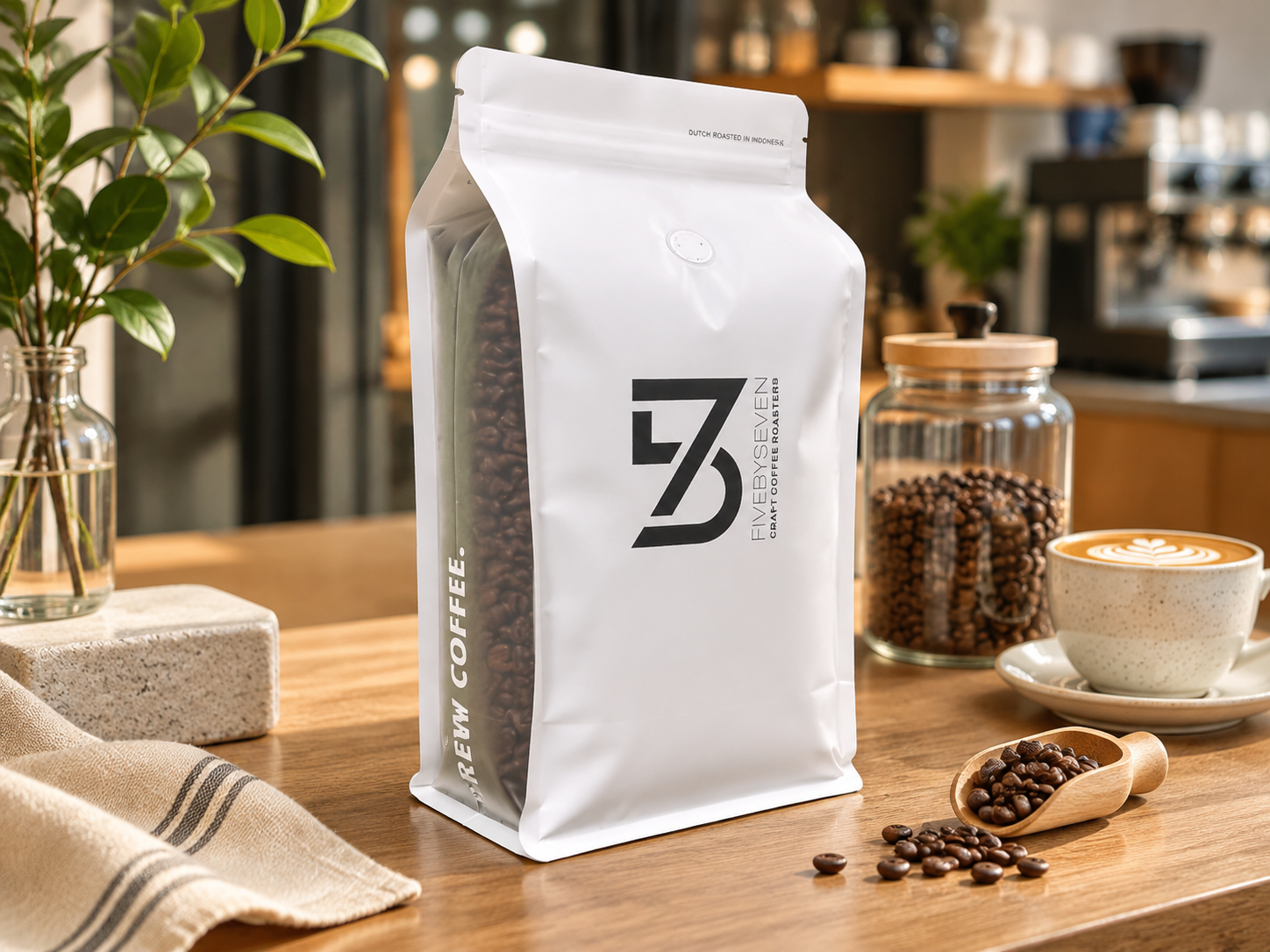
MOPP generally means matte-oriented polypropylene film, often used as an outer printable layer. VMPET is vacuum-metallised polyester; its thin metal coating adds a barrier against oxygen, moisture and light. PE is the inner heat-seal layer and, when specified for food contact, faces the coffee.
VMPET is metallised PET, not solid aluminium foil. Its barrier performance depends on film grade, metallisation, adhesive, thickness, converting and finished-bag integrity. The material code alone cannot guarantee OTR, WVTR or shelf life.
PE/PE generally means polyethylene-based outer and inner layers. It is considered for mono-PE or PE-family designs that may fit a PE recycling stream. But the code is not a full specification: PE grade, orientation, co-extrusion and barrier technology affect stiffness, sealing and barrier performance.
Do not assume a basic PE/PE structure has the same oxygen and light barrier as a metallised laminate. Engineered PE structures may use additional barrier technology, so request the exact layer breakdown. For a recyclability claim, check the valve, zipper, ink, adhesive and local recycling route too.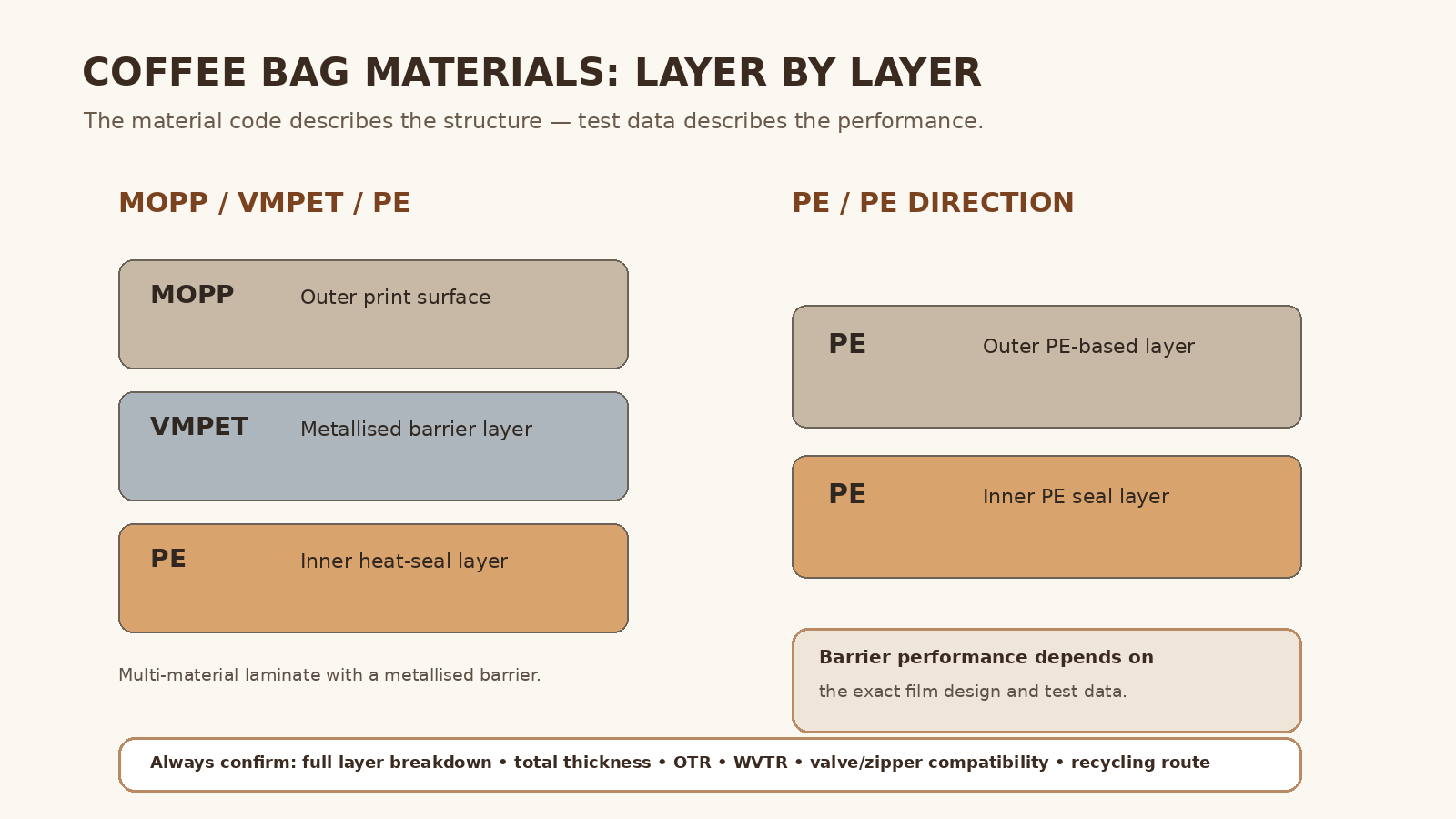
Coffee quality is affected by oxygen, moisture, light, residual air, temperature and storage time. Metallised layers are commonly used to improve protection; PE-based performance depends on the film design and added barrier technology. A general “high barrier” claim is not enough.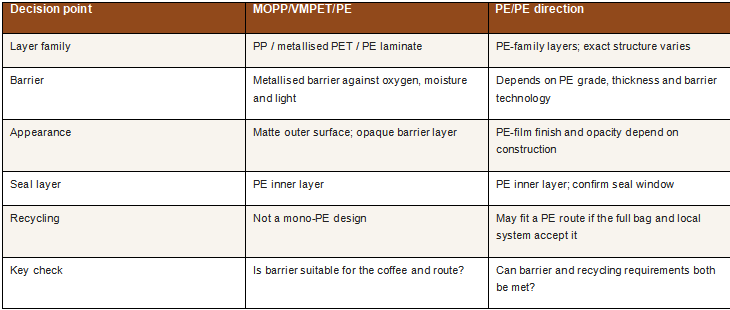
For oxygen transmission, ASTM D3985-24 measures transmission through plastic films and laminates. ASTM F1249-25 covers water vapour transmission through flexible barrier materials. Check units, temperature, humidity or test atmosphere, thickness and conditioning. Compare values only under comparable conditions.
Confirm what was tested. A report may cover flat film rather than a finished pouch. Seams, folds, valves, zippers and top seals affect the complete package. Film data helps screen materials, but does not replace testing the converted bag.
Freshly roasted coffee releases carbon dioxide after roasting. A published coffee degassing study describes how CO2 remains in beans and continues to escape during storage. A one-way valve releases gas while helping limit outside air, but does not replace barrier film or reliable seals.
Recyclability is a whole-package question. A PE film does not automatically make a bag recyclable if components or local systems are incompatible. The EU PPWR generally applies from 12 August 2026 to packaging regardless of material or origin. Use design-for-recycling evidence, not a blanket '100% recyclable' claim.
MOPP/VMPET/PE is a practical starting point when a familiar metallised barrier and matte print surface are priorities. The final specification still needs to match the coffee, distribution time, storage and filling process. For freshly roasted whole beans, confirm whether a valve is needed.
Evaluate PE/PE when a customer or market requires a PE-family structure. Select it only after the supplier provides the exact construction and barrier evidence. If the buyer sets OTR or WVTR targets, request measured values and test conditions rather than accepting a verbal 'high barrier' claim.
Neither material code has a universal shelf-life number. Results also depend on roast profile, whole bean or ground coffee, residual oxygen, valve, seals, storage and distribution. Flat-film data is useful, but a filled-pack trial is needed to assess the complete system.
Destination rules matter. In the EU, Commission Regulation (EU) No 10/2011 sets requirements for plastic food-contact materials, including authorised substances and migration limits. In the US, FDA food-contact guidance explains that requirements depend on the substance and intended use. Request matching documents.
The EU PPWR began applying on 12 August 2026, with requirements phased in over time. The European Commission’s PPWR update says the general recyclability requirement applies from 2030; certain PFAS restrictions in food-contact packaging started in August 2026. PE/PE alone is not proof of compliance.
Request a specification listing each layer, its thickness, total thickness, adhesive system and food-contact layer. Ask whether OTR and WVTR reports cover film, laminate or finished bag. Reports should identify test methods and conditions. Treat missing values as unverified.
Provide the destination market, coffee type and expected conditions. For EU projects, confirm coverage under Regulation (EU) No 10/2011 and relevant migration tests. For US projects, check the FDA basis for the intended use.
Test the finished pouch with your own coffee. Check the valve, zipper, top seal, side seals and bottom folds. Store samples under expected supply-chain conditions. For recyclability claims, request a whole-package assessment covering closures, inks, adhesives and labels.
Test the finished pouch with your own coffee. Check the valve, zipper, top seal, side seals and bottom folds. Store samples under expected supply-chain conditions. If recyclability is claimed, request a whole-package assessment covering closures, inks, adhesives and labels.
AT PACK’s published coffee bag specification lists MOPP/VMPET/PE for one flat-bottom configuration. This is not an OTR/WVTR report or a universal specification. For PE/PE, confirm the structure, barrier evidence, food-contact documents and accessory compatibility.
Conclusion
MOPP/VMPET/PE and PE/PE are different packaging approaches,
not simply 'old' and 'green' materials. The metallised laminate offers a familiar barrier approach; a PE-based structure may support recycling when the complete pack qualifies. Decide using layer data, OTR/WVTR, food-contact documents, valve and seal performance, and a coffee trial.
Share your OTR/WVTR target or destination-market recycling requirement with AT P
Is MOPP/VMPET/PE better than PE/PE for coffee freshness?
It commonly provides a stronger metallised barrier direction than a basic PE/PE structure, but the actual result must be confirmed by OTR/WVTR data and finished-pack testing.
Does PE/PE automatically mean the coffee bag is recyclable?
No. The complete structure—including valve, zipper, inks, adhesives and labels—and the local collection and recycling system all matter.
Can a degassing valve make a low-barrier bag suitable for coffee?
No. A valve helps release carbon dioxide while limiting air entry, but it does not replace an appropriate barrier material or sound seals.
ASTM International — ASTM D3985-24, Oxygen Transmission Rate Test Method
ASTM International — ASTM F1249-25, Water Vapour Transmission Rate Test Method
European Commission — Food Contact Materials Legislation
U.S. FDA — Food Packaging and Other Substances that Come into Contact with Food
U.S. FDA — Food Types and Conditions of Use for Food Contact Substances
European Commission — New EU Rules on Packaging Enter into Application
PubMed — Time-Resolved Gravimetric Method to Assess Degassing of Roasted Coffee
AT PACK — 12oz/340g Flat-Bottom Coffee Bag Product Specification
